Stepping Outside Yourself: How Walking for a Cause Does More for Your Mind Than Your Morning Jog Ever Could
Most of us already know that walking is good for us. The science has been clear on that for decades — better cardiovascular health, lower blood pressure, improved sleep. But here's what the wellness industry hasn't been talking about nearly enough: why you walk might matter just as much as that you walk. And new research is starting to back that up in some pretty striking ways.
Participants in charity walks — including the kind organized by groups like Walk to End Hunger — are showing up in studies with measurably better mental health outcomes than people who exercise alone for personal fitness goals. We're talking real, quantifiable reductions in anxiety and depression symptoms, stronger feelings of social connection, and a deeper sense of daily purpose. The gap between the two groups isn't small, either. Researchers are starting to call it a "purposeful movement" effect, and it's reshaping how psychologists think about the relationship between physical activity and emotional wellbeing.
Your Brain on Purpose
Here's the quick neurological backstory. When you exercise, your brain releases a familiar cocktail of feel-good chemicals — endorphins, serotonin, dopamine. That's the part we all learned in high school health class. But what's newer is the understanding that context changes how those chemicals interact with other brain systems.
When movement is tied to a meaningful external goal — raising money to feed a family across town, walking in memory of someone who struggled with food insecurity, crossing a finish line alongside hundreds of strangers who share your values — the brain's reward circuitry activates differently. The prefrontal cortex, which governs things like empathy, long-term thinking, and identity, gets more deeply engaged. The result isn't just a mood boost. It's closer to what psychologists describe as "eudaimonic wellbeing" — a sense of living in alignment with your values, which is a much sturdier form of happiness than the fleeting kind.
Dr. Lisa Feldman Barrett's work on how the brain constructs emotion offers a useful lens here: our emotional states are heavily shaped by the meaning we assign to our experiences. A five-mile walk to burn calories and a five-mile walk to help end hunger might look identical on a fitness tracker. But they feel — and function — very differently inside the brain.
What Walkers Are Actually Saying
Talk to people who've done charity walks and you hear a version of the same story over and over. There's something that happens around mile two or three, when the initial energy of the crowd settles and you start to really feel the weight of why you're there. People describe it as grounding. Some say it's the first time in months they've felt genuinely present.
Sarah, a 38-year-old marketing manager from Columbus, Ohio, started doing fundraising walks after a rough stretch dealing with burnout and anxiety. She'd been going to the gym regularly for years — spin classes, treadmill runs, the whole routine — but never felt like her mental health was keeping pace with her fitness level. "The gym helped, but it was kind of hollow," she says. "Walking for something — knowing that my steps were connected to real families getting real food — it just hit differently. I cried at the finish line and I'm not even someone who cries."
That emotional release isn't incidental. It's actually a sign that deeper psychological processes are at work. When we act in ways that align with our values, we experience what researchers call "moral elevation" — a warm, expansive feeling that's been linked to reduced cortisol levels and increased prosocial behavior. In plain English: doing good feels good, and that feeling has measurable biological consequences.
The Loneliness Variable
There's another piece to this puzzle that's easy to overlook: charity walks are, by nature, communal. And community, as it turns out, is one of the most powerful mental health interventions we have — and one of the most underused.
The United States is in the middle of a loneliness epidemic that the Surgeon General has officially flagged as a public health crisis. Tens of millions of Americans report feeling chronically isolated, and that isolation is tied to significantly higher rates of depression, anxiety, and even early mortality. Solo fitness routines, however admirable, don't do much to address that underlying deficit.
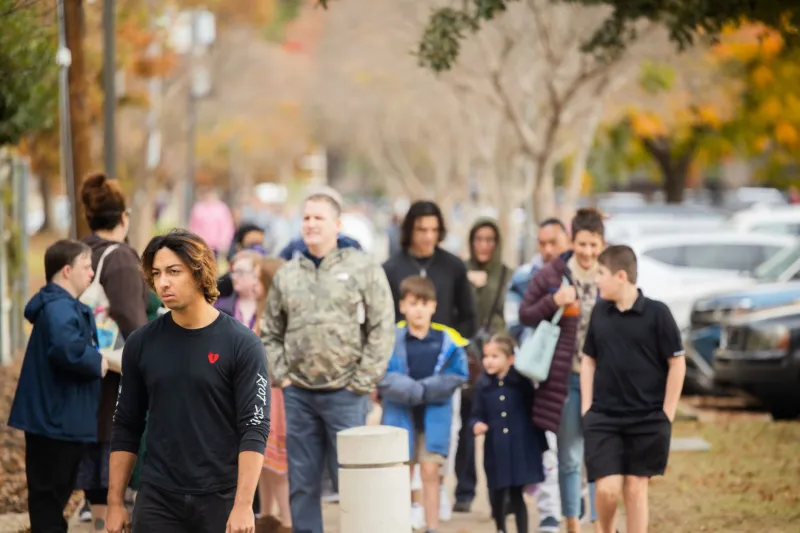
Charity walks drop people into an instant community of shared purpose. You're walking alongside your neighbor, your coworker, a stranger from a different zip code — all of you moving in the same direction, literally and figuratively. The social bonds formed in those moments, even brief ones, activate the brain's attachment systems in ways that gym sessions simply can't. Research on group exercise consistently shows stronger mood improvements than solo workouts, and that effect is amplified when the group has a unifying mission.
Why Traditional Wellness Culture Misses This
Here's the uncomfortable truth: the wellness industry is largely built around individualism. Track your steps. Hit your macros. Optimize your recovery. It's all framed around you — your body, your goals, your metrics. That's not inherently bad, but it's incomplete. It treats mental health as a byproduct of physical optimization, when the reality is more nuanced.
Purposeful movement flips the script. Instead of walking to improve yourself, you're walking to improve something beyond yourself. And paradoxically, that outward orientation produces better inward results. Psychologists have long noted that people who orient their lives around contribution and connection — rather than personal achievement alone — tend to report higher baseline wellbeing. Charity walks are, in a sense, a practical, accessible way to embody that principle for a few hours on a Saturday morning.
Walk to End Hunger has always known this intuitively. Every step in our events is tied to a larger story — the story of food insecurity in America, of families skipping meals, of communities working together to change that reality. Participants aren't just getting their steps in. They're becoming part of something.
Making It Count Beyond the Finish Line
The mental health benefits of purposeful walking don't have to end when the event does. Researchers suggest that the psychological gains are most durable when participants stay connected to the cause — following up on fundraising outcomes, sharing their experience with others, or committing to the next walk.
That's part of why events like ours build in storytelling, community updates, and ongoing engagement. The walk is a catalyst, not a conclusion. The more you stay connected to the why, the more that sense of purpose continues to buffer against everyday stress and anxiety.
So the next time someone asks whether a charity walk is "really" a workout, you can tell them it's actually something more. It's a workout for your legs and your nervous system, your sense of community and your sense of self. And right now, when mental health challenges are at historic highs and hunger affects one in eight Americans, that kind of movement might be exactly what we all need a little more of.
Lace up. Show up. Walk for something bigger than yourself — and watch what happens to your mind in the process.