What You Walk Past Every Day Might Be the Hunger Crisis You Never Knew Existed
There's a community fridge on the corner of Maple and 5th in a mid-sized Ohio city. It gets restocked on Tuesdays. By Thursday afternoon, it's empty. Most people who walk past it on their lunch break don't even glance at it twice.
That fridge — and thousands like it scattered across American cities and suburbs — tells a story that most of us are too distracted to read. It's a story about hunger. And it's happening right on your route to work, to the gym, to your kid's school.
Here at Walk to End Hunger, we talk a lot about the power of movement. But there's a version of walking that doesn't get nearly enough credit: the kind where you actually look around.
The Hidden Geography of Hunger
Food insecurity in the United States affects roughly 44 million people, including more than 13 million children, according to data from Feeding America. But those numbers can feel abstract when you're scrolling through your phone. What doesn't feel abstract is a shuttered grocery store in your neighborhood that's been empty for three years, replaced by a dollar store that sells chips and canned soup.
Food deserts — areas where residents have limited access to affordable, nutritious food — aren't just a rural problem. They exist in dense urban zip codes, in suburban pockets, in communities that look perfectly fine from the outside. The USDA estimates that around 19 million Americans live in low-income areas that are more than a mile from a supermarket, a distance that might seem trivial until you factor in no car, no bus line, and two kids under five.
These communities don't announce themselves. You have to know what you're looking for.
Learning to Read Your Route
Marissa T., a nurse from Atlanta who started walking charity routes two years ago, describes the moment she noticed something different about her regular 3-mile loop through her neighborhood.
"I'd been doing the same walk for months," she says. "And one day I actually stopped and looked at the community bulletin board outside the library. It was covered in flyers for food pantries, emergency food programs, meal assistance for seniors. I had walked past that board probably 200 times. I had no idea."
That moment of awareness changed how Marissa walked — and eventually, what she did with her walks. She started connecting with her local food bank, joined a Walk to End Hunger fundraising team, and now organizes neighborhood awareness walks that route participants specifically through the areas where food access gaps are most visible.
"People are shocked," she says. "They'll walk past a shuttered grocery store and find out it closed because the neighborhood's average income dropped below the threshold the chain considered profitable. That's not abstract. That's your block."
Marissa's experience isn't unique. Across the country, walkers who engage intentionally with their surroundings are becoming some of the most effective local hunger advocates around.
What to Actually Look For
So what does food insecurity look like from the sidewalk? It's not always obvious, but once you know the markers, you start seeing them everywhere.
Empty or overwhelmed community fridges. These mutual aid resources are a direct indicator of neighborhood need. If a fridge is consistently empty by mid-week, that's a signal demand is outpacing supply.
No full-service grocery stores within walking distance. Dollar stores and convenience stores don't count. If your neighborhood's only "grocery option" doesn't sell fresh produce, that's a food access problem.
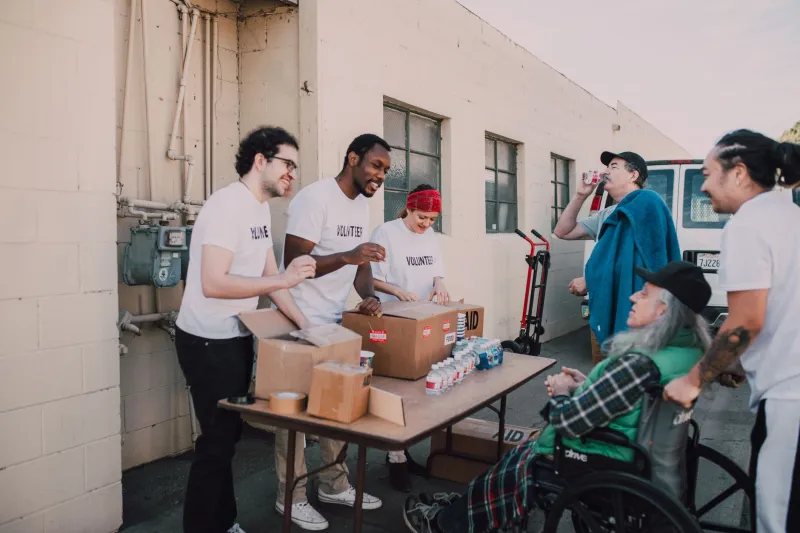
Long lines at food pantries or mobile distribution sites. Many food banks and pantries operate out of church parking lots, community centers, or school gyms. If you see a line forming on a weekday morning, that's not a coincidence.
Flyers for emergency food assistance. Laundromats, library bulletin boards, bus stops — these are often where food assistance programs post notices because they know that's where food-insecure families spend time.
Closed businesses that were once food-related. A shuttered restaurant, bakery, or corner market can signal economic decline that often correlates with food access challenges.
None of these signs mean you should assume the worst about a neighborhood. But they do mean you should pay attention — and ask questions.
Why Bearing Witness Actually Matters
There's a concept in community advocacy called "proximate awareness" — the idea that people are far more motivated to act on problems they physically encounter than on problems they only read about. It sounds obvious, but it has real implications for how hunger campaigns work.
When you walk past an empty community fridge, something happens in your brain that a statistic can't replicate. You feel it differently. That feeling is valuable — not just emotionally, but strategically. It's the thing that turns a passive donor into an active advocate.
This is part of why Walk to End Hunger's model of fundraising walks is so effective. It's not just about the miles. It's about the route. It's about what you see, who you talk to, and what you decide to do when you get back home.
Turning Awareness Into Action
Okay, so you've started paying attention. Now what?
The good news is that the same walk that opened your eyes can also be the mechanism for change. Here are a few concrete ways to translate neighborhood awareness into neighborhood impact:
Map your local food access gaps. Apps like the USDA's Food Access Research Atlas let you overlay food desert data on real maps. Walk your neighborhood with that data in hand and see what matches up.
Join or start a fundraising walk route that tells a story. Instead of a generic loop through a park, design a walk that passes through areas of food insecurity. Brief participants on what they're seeing. That kind of experiential fundraising sticks.
Partner with local food banks. Many food banks will work with community walkers to identify high-need areas and help connect donors directly to local impact. Your miles can fund local shelves, not just national statistics.
Advocate for structural change. Awareness is the beginning, not the end. Contact your city council member about zoning policies that push grocery stores out of low-income neighborhoods. Support community-led food cooperatives. Show up to public meetings.
Restock that community fridge. Seriously. It costs less than a restaurant lunch and it helps someone in your neighborhood eat today.
Every Step Is a Choice About What You Notice
Walking has always been about more than fitness. For most of human history, it was how we learned the world around us — how we built maps in our minds, how we understood who shared our community and what they needed.
Somewhere along the way, we started walking with our heads down and our earbuds in. We stopped seeing the bulletin boards, the empty fridges, the shuttered stores.
You don't have to walk very far to find hunger in America. You just have to look up.
And once you do, once you really see it, it becomes a lot harder to walk away without doing something about it. That's not a guilt trip. That's just how human beings work when they're paying attention.
This is what Walk to End Hunger is really about. Not just the finish line, but everything you notice along the way — and everything you decide to do about it when you get there.
Ready to start walking with intention? Find a Walk to End Hunger event near you at walktoendhunger.org and help us turn every mile into a meal.